What is a Hash Function?
A “hash function” is a mathematical algorithm that transforms any input data (such as text or files) into a fixed-length string of alphanumeric characters, called a hash value. Cryptographic hash functions have several key characteristics:
- One-wayness: It is computationally impossible to reverse the hash value back to the original input.
- Determinism: The same input always produces the exact same hash value.
- Collision resistance: It is extremely unlikely that two different inputs will produce the same hash value.
- Avalanche effect: A tiny change in the input (even a single character) yields a completely different hash value.
However, different hashing algorithms have different designs and processing speeds. Using the wrong algorithm for a specific task can lead to severe security vulnerabilities.
Fast Hashing vs. Slow Hashing: The Core Concept
The most critical factor when choosing a hash function is its computational speed.
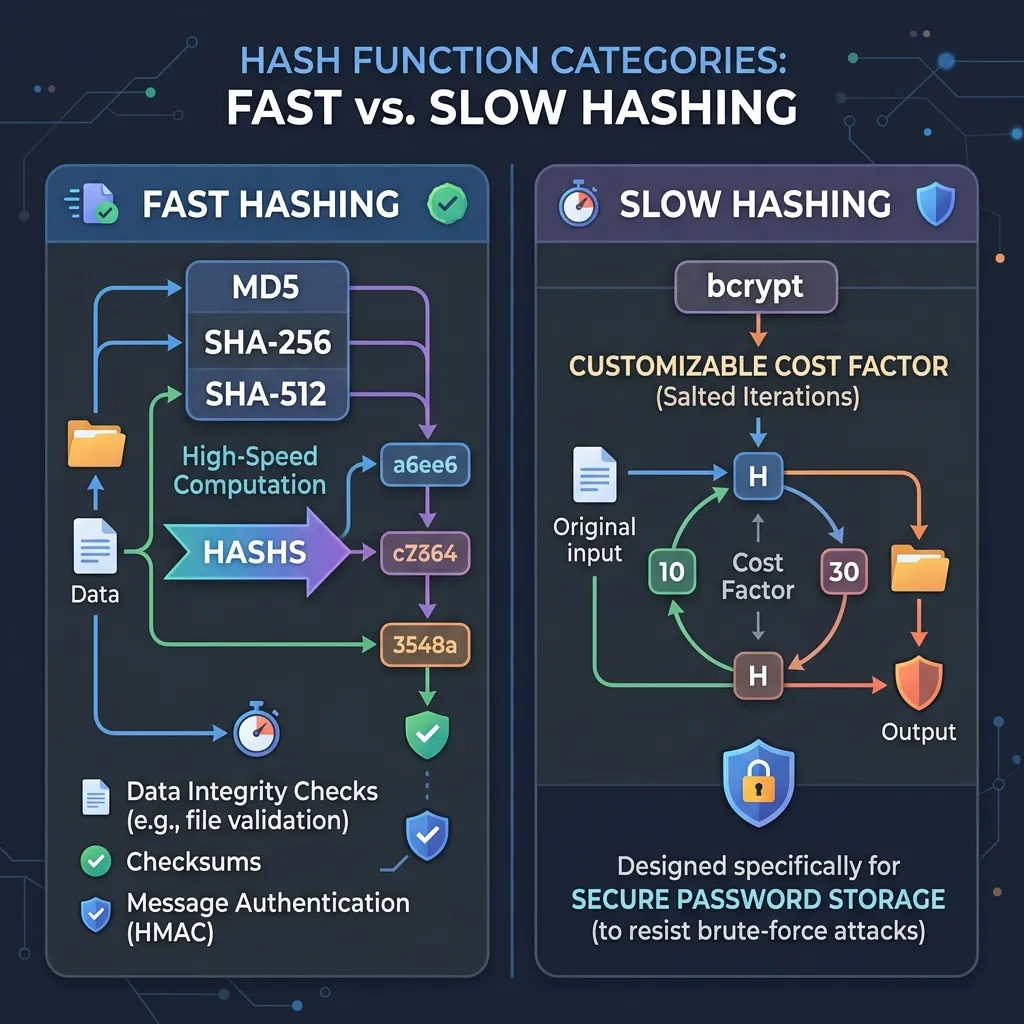
Fast Hashing (MD5, SHA-256, SHA-512, etc.)
These are optimized to process massive files quickly for data verification. Because of this speed, you must never use fast hash functions for storing passwords. If an attacker gains access to your database, they can use powerful GPUs or dedicated ASICs to compute billions of guesses per second, quickly cracking the original passwords via brute-force or rainbow table attacks.
Slow Hashing (bcrypt, etc.)
These are designed specifically for password storage. They are deliberately slow to compute (taking milliseconds per hash) and support a configurable “cost factor.” Additionally, they automatically embed a random “salt” into each hash, rendering GPU-accelerated cracking and precomputed rainbow table attacks practically useless.
At a Glance
| Algorithm | Category | Computational Speed | Primary Purpose | Security Strength |
|---|---|---|---|---|
| MD5 | Fast Hash | Extremely fast | Non-security tasks (checksums, legacy systems) | Vulnerable (prone to collision attacks; do not use for security) |
| SHA-256 | Fast Hash | Fast | Data integrity, digital signatures, blockchain | Strong (industry standard for general security) |
| SHA-512 | Fast Hash | Fast | High-security data integrity | Very Strong (longer outputs than SHA-256) |
| bcrypt | Slow Hash | Configurable (Slow) | Password storage | Excellent (the gold standard for storing passwords) |
| HMAC | Keyed Fast Hash | Fast | Tampering detection, sender authentication | Strong (depends on the underlying hash function) |
| CRC16 / CRC32 | Checksum | Instant | Network transmission check, ZIP file validation | Zero (non-cryptographic; offers no protection against malicious edits) |
Detailed Explanations & Use Cases
MD5: Fast but Vulnerable, Only for Basic Checks
Developed in the early 1990s, MD5 (Message Digest Algorithm 5) produces a 128-bit hash value. Because techniques to construct collision attacks (generating different files with the same MD5 hash) are widely available, MD5 must not be used for security purposes like password storage or digital signatures. Today, it is only suitable for simple error checks (e.g., verifying a file download didn’t corrupt) or legacy system compatibility.
SHA-256 & SHA-512: The Standard Cryptographic Fast Hashes
Part of the SHA-2 family, these are the most widely trusted cryptographic hash functions in modern computing. SHA-256 produces a 256-bit hash (64 hex characters) and SHA-512 produces a 512-bit hash (128 hex characters). No practical collision attack exists against them.
- SHA-256: Used in SSL/TLS certificates, Git commit hashes, Bitcoin mining, and digital signatures.
- SHA-512: On 64-bit processors, SHA-512 is often faster than SHA-256 because it processes data in 64-bit blocks. It is chosen when maximum security strength or longer outputs are required.
bcrypt: The Gold Standard for Password Storage
bcrypt is a slow-hashing algorithm designed specifically for hashing passwords. It lets you configure a “cost factor” (salt rounds) that increases the computational work exponentially, slowing down attackers.
Its most notable feature is that hashing the same password twice yields completely different outputs. This happens because bcrypt automatically generates a random “salt” for each password and embeds it at the beginning of the hash string. When authenticating, the system reads the salt from the stored hash, computes the bcrypt hash of the user’s input, and compares the results.
HMAC: Message Authentication with a Secret Key
HMAC (Hash-based Message Authentication Code) calculates a hash value by combining the input data with a “secret key.” Even with the same input, the output changes if the key changes. This allows you to verify not only that the data was not tampered with, but also that the sender possesses the correct secret key. HMAC-SHA256 is the standard choice for API request signing (like AWS Signature) and verifying incoming Webhooks (such as Stripe or GitHub).
CRC16 / CRC32: Checksums for Communications
CRC (Cyclic Redundancy Check) is a checksum rather than a cryptographic hash. It is mathematically simple and designed to run extremely fast on network hardware or CPUs. It is used to detect transmission errors (e.g., in Ethernet frames or ZIP/PNG files). It has no cryptographic security, meaning an attacker can easily manipulate a file to match a specific CRC checksum.
Summary: Quick Selection Rules
- To store passwords in a database ➔ Use bcrypt Hash Generator (cost factor 10–12 recommended).
- To verify files or data integrity ➔ Use SHA256 Hash Generator or SHA512 Hash Generator.
- To sign API requests or verify Webhooks ➔ Use HMAC Generator.
- To detect simple data transmission errors (e.g., ZIP/PNG) ➔ Use Checksum Calculator (CRC16/CRC32).
- For legacy system compatibility or non-secure checksums ➔ Use MD5 Hash Generator.